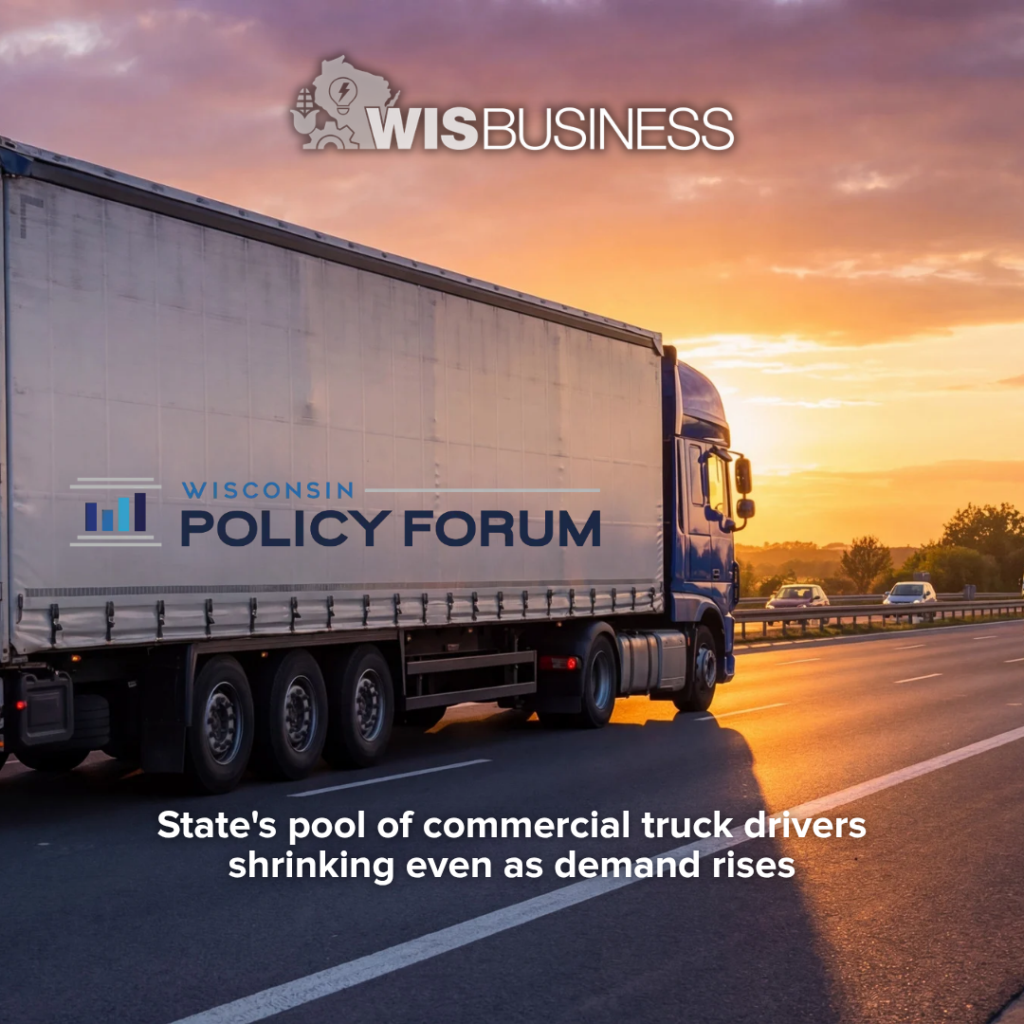
Wisconsin’s pool of licensed commercial truck drivers is shrinking even as the state’s reliance on trucking to drive the economy has grown, a new study from the Wisconsin Policy Forum shows.
The number of people licensed to handle big rigs hasn’t kept pace with this demand, and with an aging workforce behind the wheel of those heavy trucks, the supply could shrink even further, authors wrote.
The report found 70% of goods, by weight, move through Wisconsin via highways, with an increase of 33% in those shipments between 2019 and 2023. And federal officials project an increase nationally of 50% by 2050 for the amount of freight shipped by truck.
But as the volume of those shipments has increased, the number of people in Wisconsin licensed to drive them has dropped by more than 20,000, or 8.9%, over the past 15 years.
The Wisconsin Department of Transportation produced a white paper in 2022 that identified some factors at play. That includes retirements and a loss of licenses due to rule-based disqualifications, drug tests and poor driving records. The study also cited a drop in pay and working conditions.
There have been several efforts to help boost the number of licensed CDL drivers, including a state grant program created in 2024 that helps cover the cost of training. That led to $250,000 in grants in 2026 awarded to help 170 new license holders.
Meanwhile, the Wisconsin Policy Forum suggested autonomous vehicles may eventually be part of the solution, though the deployment of the technology is not moving rapidly enough to make up for the shortage in licensed drivers.
Authors point to Roehl Transport, headquartered in Marshfield, as one example of progress being made in the state. The company has been involved in a project testing self-driving trucks, deploying vehicles on a route between Dallas and Houston.
“This example, and other Wisconsin experiences, shows that in the future there may be less need for trained drivers behind the wheel,” authors wrote. “However, legal and technological progress in this area has been relatively slow, and any use of autonomous vehicles will ultimately be a political decision that is difficult to predict.”